impossible it’s possible*
I have a confession: I’ve always been really judgmental about Cinderella.
Cursory research tells me that this widely-shared folk tale goes way, way back for humans: like, 1st century CE (shout out to Grecian Rhodopis, our purported first slippered heroine). But the version in my head is a blend of talking mice, a patched dress, “Fol-de-rol and fiddledy dee,” a glass slipper, the incomparable Brandy & Whitney, “my own little corner in my own little chair,” & that powder-blue ensemble complete with pearls & a…black choker? Yeah, that one. She’s never been a conscious favorite of mine (that’s Belle—duh)—-a woman subjegated by those who should love her most, she is a gentle spirit who is rewarded-slash-rescued by way of a prince who has trouble recognizing her without her makeup on. Yuck.
As part of processing through my spiritual director’s observation that “I don’t live in reality” (how dare she speak the truth), I recently made a collage contrasting two different types of “Cinderellas” to meditate on the comparison of fantasy & reality & consider what it means to inhabit one or the other. Exhibit A:
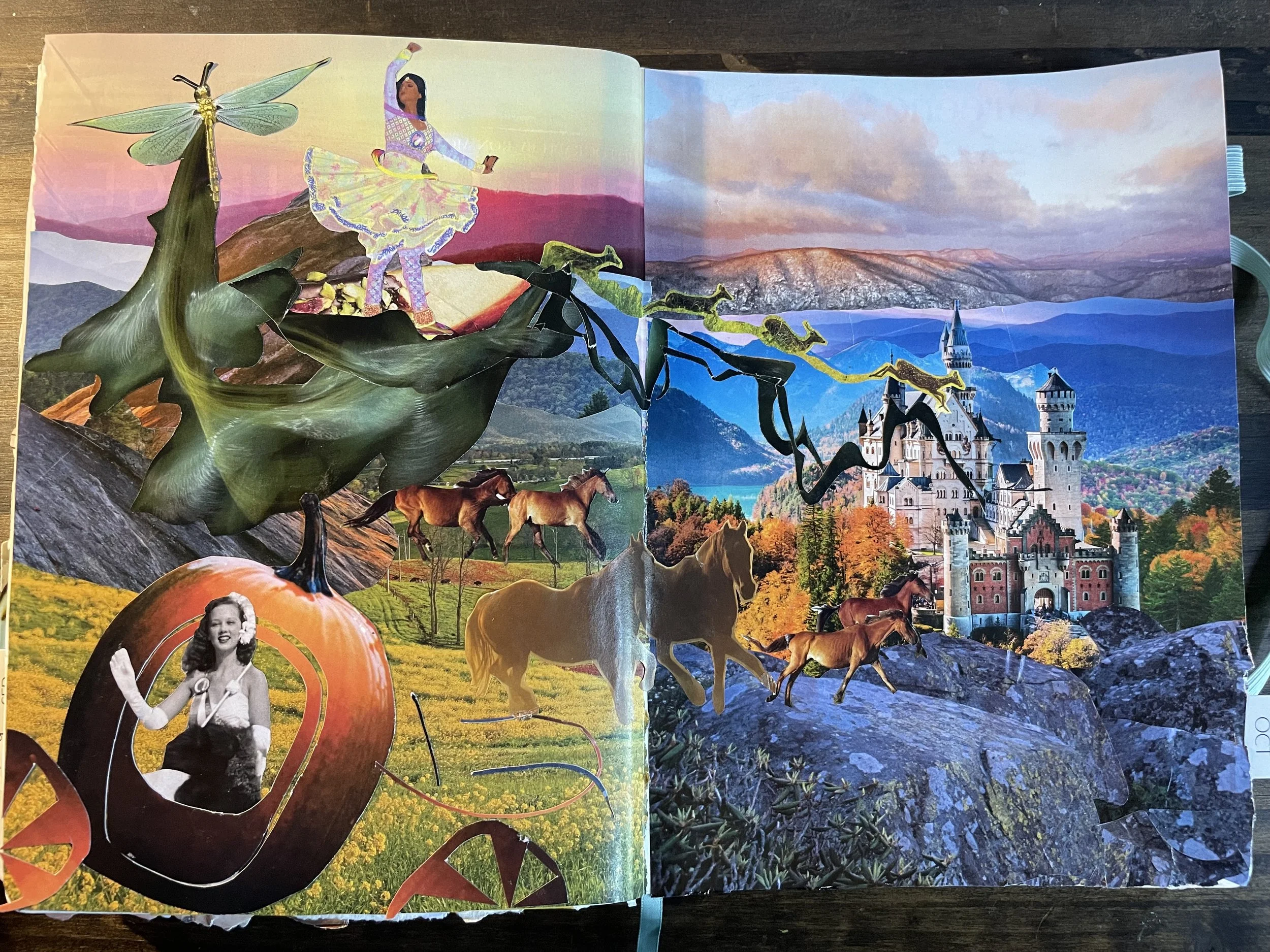
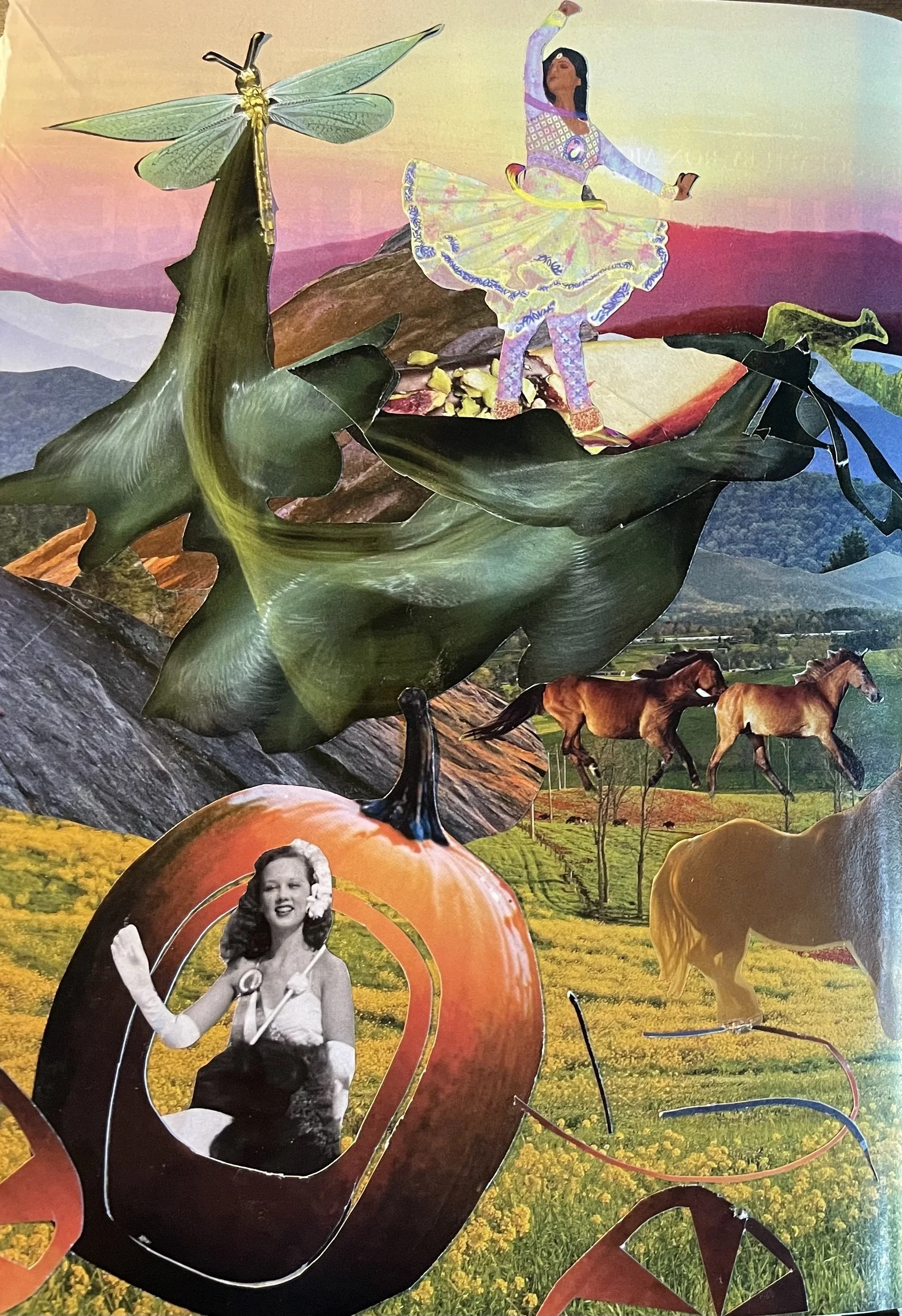
It’s a little difficult to remember now, but I think the pumpkin-riding Cinderella was meant as the fairy tale version, frozen in one narrative even as it breaks apart around her. Ironically (I now observe), the one following nature’s lead into wild freedom as she soars towards the castle was my idea of reality. I clearly channelled most of my creative energy into the sky-dancing Cinderella, but when all was said and done, I found myself continually drawn back to the beauty queen in black and white.
She was there as a backdrop, to be a contrast, but she is becoming the central story. The more I consider her, the more I begin to see the “hero” part of this heroine. How did she come to be in that pumpkin in the first place? Though I had portrayed her as stuck, clueless to her situation, no matter how I parse that question, one answer keeps returning: She is there because she said “yes.”
Honestly, it’s hard to imagine a more difficult or courageous act for someone in her story. How absurd that I always connected her with words like “helpless,” “hopeless,” “compliant,” & “weak.” How ill-fitting they seem to me now.
Held captive by hate & dehumanized, Cinderella manages to maintain a gentle, sweet, hopeful spirit. Though she is refused the power & dignity she deserves, she doesn’t wait for permission to nurture it within herself. Her presence fills the world around her with life, order, beauty, friendship, & music. From quiet inner strength, she extends to others what she, herself, is denied: voice, safety, empowerment. Her family continually cuts her down, but they can’t stop the flourishing that springs out of her every step. Even their most hateful poison doesn’t reach her tender heart: what might have alchemized into hatred & bitterness within her instead produces honest sadness & vulnerability.
By all accounts, Cinderella’s situation reads as hopeless, but she diligently does what she can within her circumstances even while actively dreaming beyond them. She finds herself “impossibly” in a pumpkin coach because she accepted all the “possible” (however small) that came before: In a world full of “no,” Cinderella chooses “yes” time after time.
yes to dreaming—-the manifestation of belief in goodness & hope;
yes to so investing in self-worth that inclusion in a palace invitation feels perfectly plausable;
yes to making a plan & doing whatever is in her power to take herself to the ball (how could I ever have seen her as a wilting flower waiting around for rescue??).
When her own work is not enough, she says yes to help! Not just any kind of help, but help that defies both her reality & wildest dreams. SHE GETS INTO A PUMPKIN, FOR GODSAKE. It is because of all that Cinderella has within that the fairy godmother can appear in the eleventh hour with aid: she merely utilizes what is already present to take Cinderella the distance she couldn’t go alone.
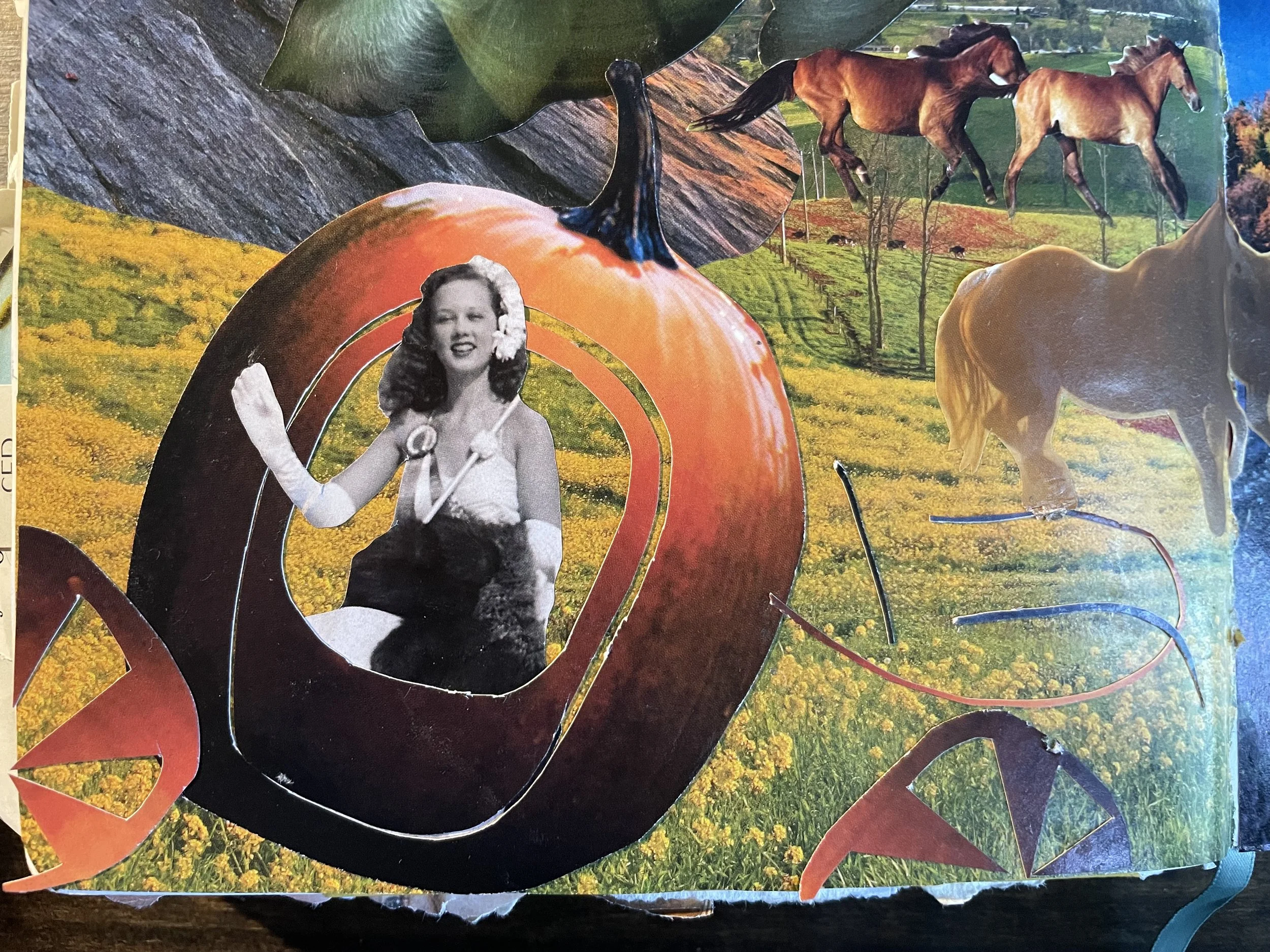
I look back at my artistic meditation & feel foolish to have ever seen this smiling “Cinderella” as silly & stuck in a broken-down dream. The “quiet revolution” of her life before this moment is enough to prove that when that coach turns back into a pumpkin, she will simply find the next “yes” available & grab hold. I have to laugh at myself: despite every intention, I couldn’t manage to conjure a helpless Cinderella, though I did try.
I used to think it was the fairy godmother’s power alone that brought about Cinderella’s happy ending. The magic certainly helped! But it was always a temporary measure. Cinderella had to meet that magic with her own magic so that the effects would last when the exterior enchantment faded. Cinderella couldn’t have known for what moment she was courageously cultivating her inner power, but she did it anyway, so she was ready to recognize & seize the moment when it arrived.
This changes everything for me about the story’s end, of course (though I can still roll my eyes at Prince Charming). It was Cinderella’s audacity & courage that made her visible, so she remained visible even after returning to the ashes of her situation. This tenacity doesn’t even end with the pumpkin, as impressive as that is, but continues to carry her from the fireplace to the parlor, where she says “yes” to sticking out her foot so that the prince can return what’s hers.
I fell for it, didn’t I? Believing that the stepmother, prince, & fairy godmother are the power-wielders of the story. Turns out that control, prestige, visibility, money, & magic aren’t the only sources of power after all. Kindness, vulnerability, hard work, beauty, humility & self-belief can take you all the way to the castle.
I can’t claim that any of this was the first impression of my collage, but looking now at the images I chose & how I placed them, I see that these Cinderellas reflect powerful, tenacious women that are not in competition but share a dream big enough for everyone; despite having their own path to the palace, they co-journey with each other & with creation—-all are giving, receiving, & enjoying the advantages of traveling alongside others.
Furthermore, I can’t actually tell which was supposed to be my “fairy tale” Cinderella & which my “real” one. Ultimately, I guess the choice is up to me. Whatever the journey looks like on the outside—flying through clouds or hiking up skirts to traipse through wildflowers—I think a “Cinderella Principle” can be affectively applied. That is to say, I can “live in reality” by
looking for questions & possibilities passing through my orbit;
cultivating an open heart that combats evil with good;
seizing opportunities that fall within my current capacity (however small);
& nurturing a “yes” that is ready, courageous, & undaunted by fear or failure…
…even if it means I might have to ride a while in a pumpkin.
*title of a Rogers & Hammerstein’s Cinderella song
